Who Is Qualified for This Work Today? - Introducing Competence Management
Most organizations can show that training happened. Fewer can show that the right people are qualified against the procedures in effect right now.

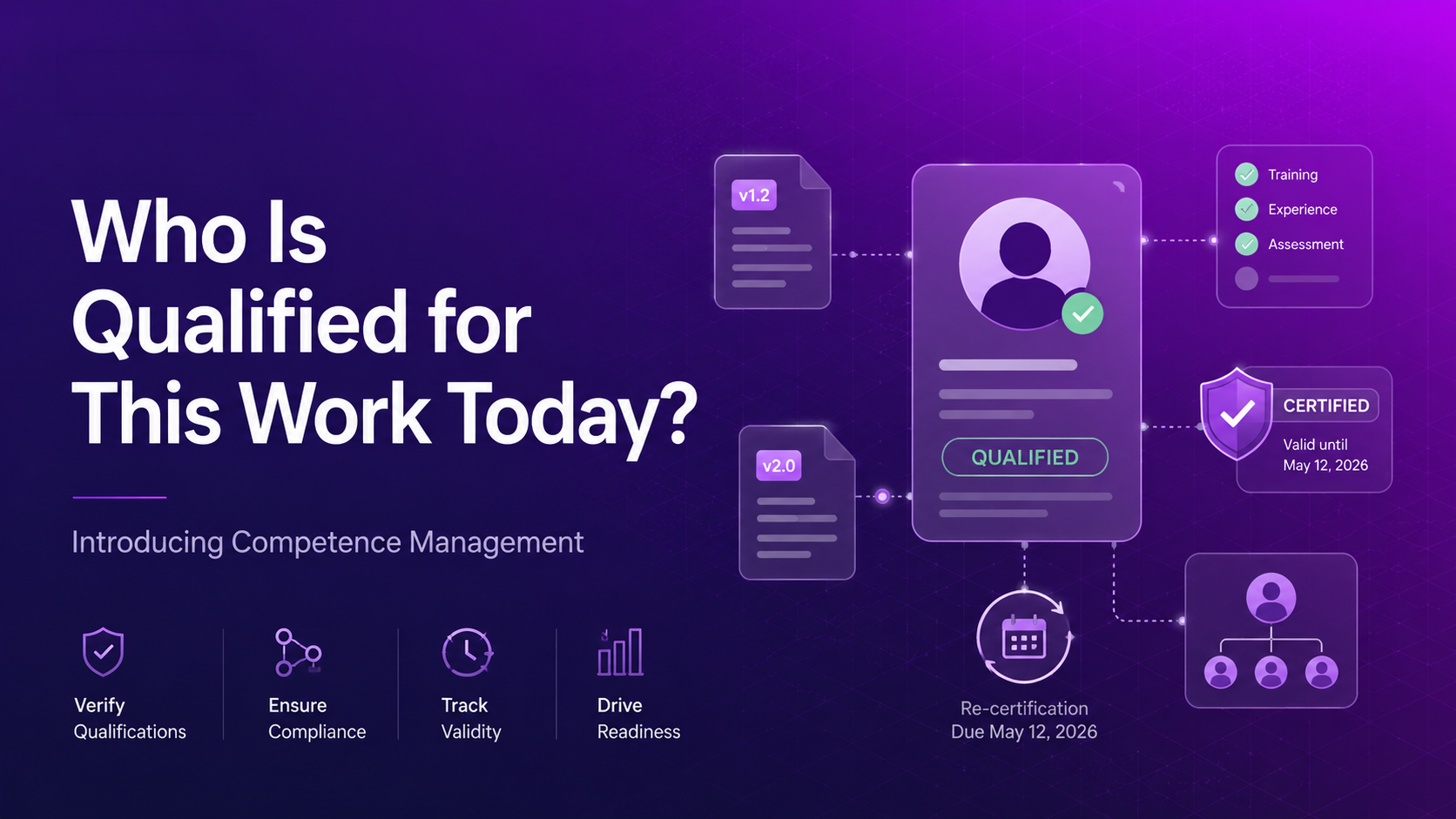
Here's a question that can start a difficult week at any regulated manufacturing site:
"Your chemical handling procedure was updated in March. Show me who is authorized to work under the current version, and what evidence you have."
It's a reasonable thing to ask. It is also painful to answer when the SOP lives in one system, exam results in another, and licenses or third-party certificates in a spreadsheet someone updates when they remember.
EduBase Competence Management is built for that question. This post will explain the business problem it solves, why that problem is harder than it looks, and how the pieces fit together.
The business problem
Regulated and safety-critical workplaces must do two things at once:
- Keep procedures current (SOPs, work instructions, safety sheets, equipment manuals).
- Prove that people doing the work match those procedures with evidence an auditor can follow.
ISO 45001 clause 7.2 is explicit: determine competence needs, ensure workers are competent, take action to maintain competence, and retain documented information as evidence. The ISO 9001 auditing practices group makes a related point that comes up in real audits: a training attendance record shows someone was present. It does not, by itself, show they are competent, or that they were trained on the procedure version that applies today.
Industry guidance on ISO 45001 audits often cites the same gaps: attendance tracked without competence verified, and training not refreshed when processes or hazards change, so records drift from the controlled revision in force.
So the business problem is not needing more courses. It is keeping qualification status aligned with the documents that actually govern the work, and being able to demonstrate that alignment without a manual reconciliation project every time something changes.
Why this is hard in practice
Most teams already run the pieces but haven't closed the gaps.
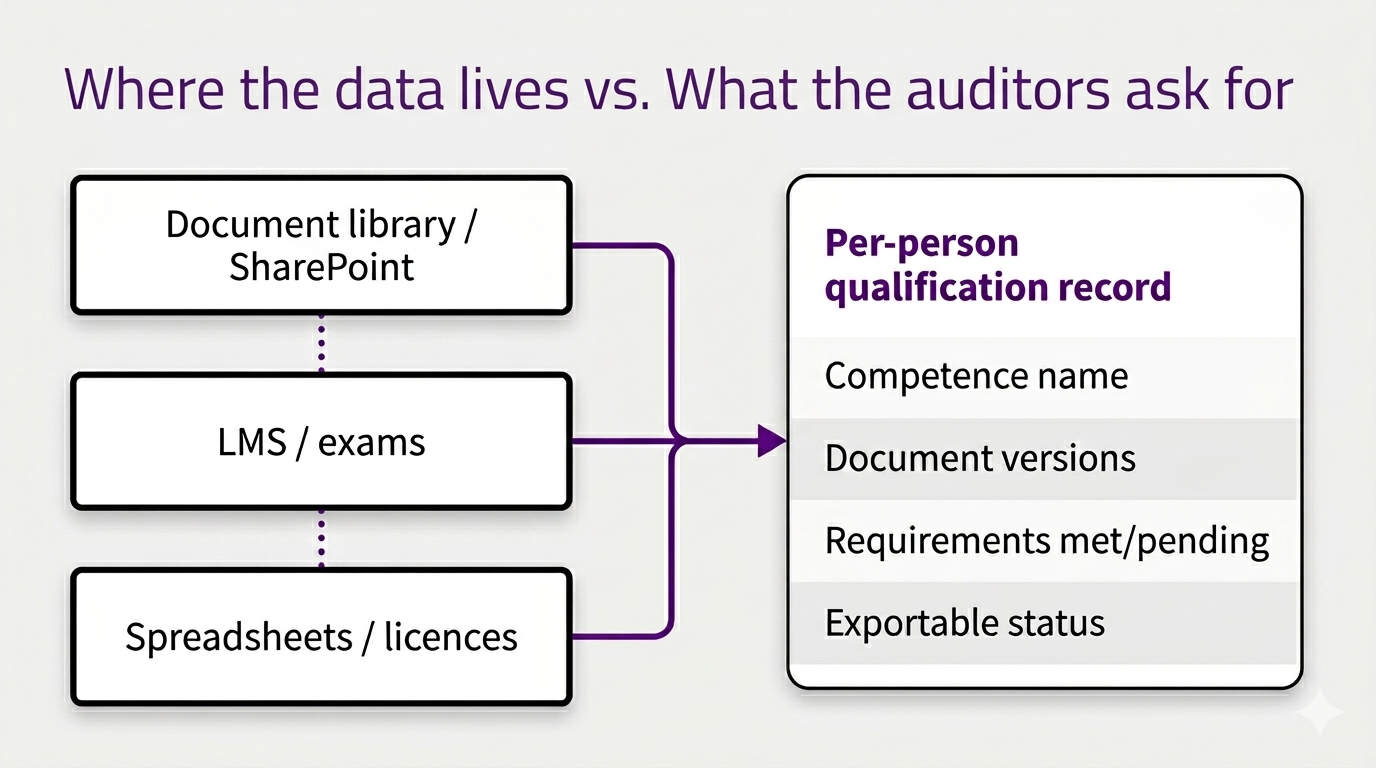
Systems rarely share one definition of what "qualified" means. Documents sit in SharePoint, Google Drive or a QMS, if not on a local computer. Exams sit in an LMS, or worse, on paper. HR holds role descriptions. Licenses and external certs sit in email, PDFs, or in a folder somewhere. When a procedure is revised, nobody has a built-in list of who was certified against the previous version.
Expiry reminders solve only part of the problem. Annual refreshers and certificate expiry dates are calendar-driven. The risky gaps are often change-driven: a near-miss leads to a revised SOP, a regulator clarifies a rule, a new chemical appears on site. Training validity should reset when the source material changes, not only when the calendar notification says so.
"Trained" and "qualified" get mixed up. Completing a course or passing a test once is a milestone. Qualification for today's work is a state: met requirements, against current source documents, including non-digital proof where the job demands it (license class, forklift cert, supervisor sign-off on a practical skill, just to name a few examples).
Many document-centric training modules stop at read-and-acknowledge (also known as read-and-sign) or a one-time completion flag. For low-risk annual refreshers, attested completion may still satisfy an auditor. On critical SOPs and role qualifications, on the other hand, the gap shows up quickly: you need evidence of understanding tied to the revision in force, not only a timestamp on a read status.
Re-certification is a process decision, not a file upload. Good compliance teams do not want every fix of a typo to invalidate hundreds of records the moment a PDF is uploaded. They want control over which changes require new proof, then tooling that finds affected people and tracks completion. That is slower to build than a simple document library, which is why many platforms stop at storage plus annual reminders.
What a workable answer looks like
You need a record for each person and each qualification that matters:
- Names the competence (what they must hold).
- Points to the versioned documents that define the work.
- Lists requirements (digital exams and real-world milestones).
- Shows current status (met, pending, needs re-certification).
- Exports cleanly for audits and HRIS/EHS sync.
When a material changes, you need a deliberate path:
- update documents,
- add or adjust requirements,
- surface who completed the old requirement,
- notify, and
- track who has caught up.
The goal is traceability that an auditor can follow in minutes: from a person to the competence, the document versions that define the work, and each requirement met or still open, and from a procedure revision to everyone affected, without rebuilding spreadsheets the week before the visit.
That is the model EduBase Competence Management implements.
The solution: one qualification record per person
Competence Management lives inside each organization on EduBase as the training-and-competence layer. It works together with the Document Library (versioned organizational documents) and the existing exam system.
At the center is a competence: a named qualification (for example, hazardous materials handling authorization) with an optional external identifier so the same competence can map to codes in your HRIS or EHS system of record.
Each competence links to
- source documents from the Library (with full version history),
- requirements members must satisfy to hold it, and
- assignment rules that determine who must hold it.
Each assigned member has a status that updates as requirements are met.
Versioned documents in the Library
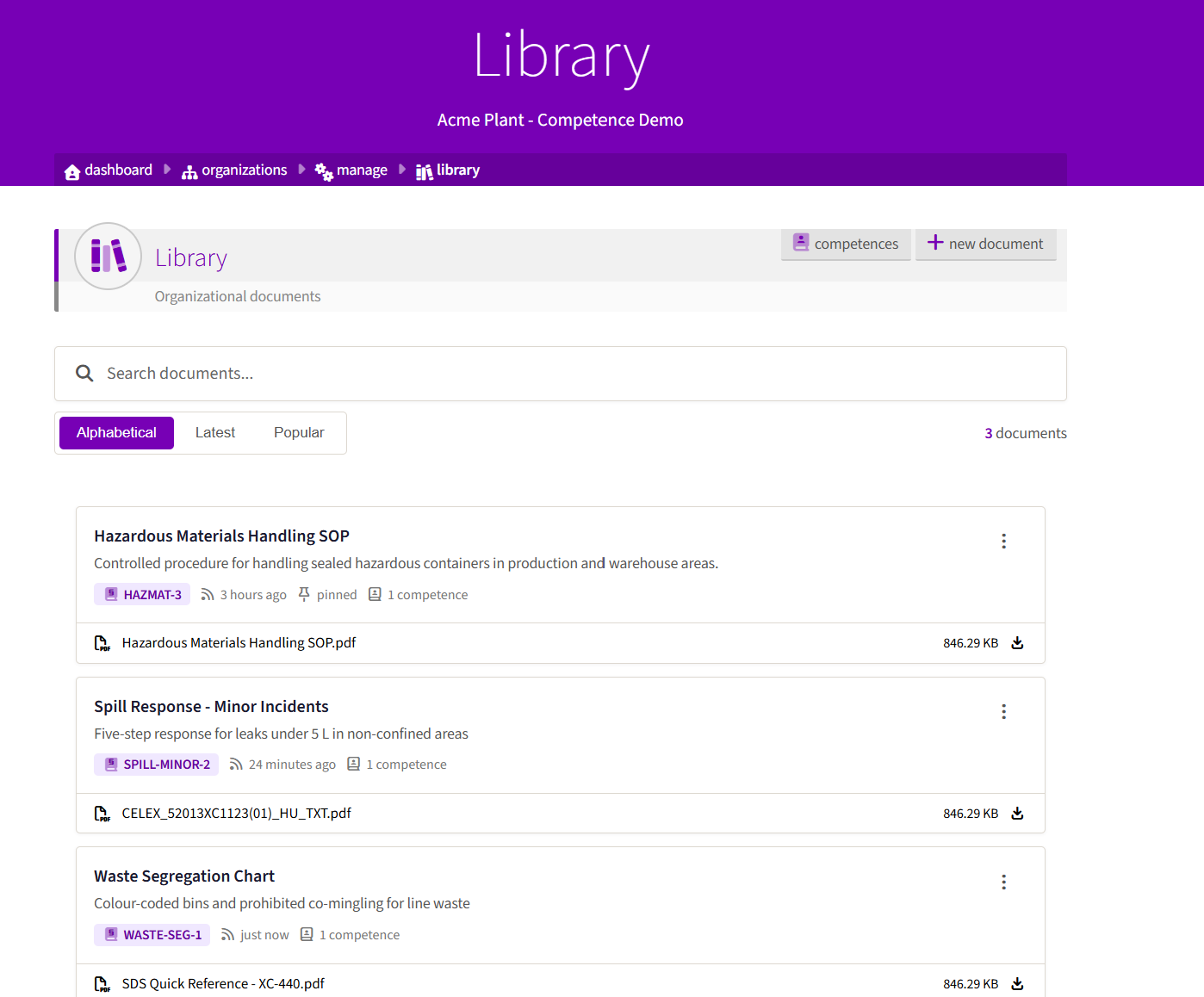
Organizational documents live in a per-organization Library with full version history. Each version has its own metadata and files. Identifiers use a customizable prefix (for example HAZMAT-1, HAZMAT-2, HAZMAT-3) so auditors and operators can refer to the same revision in conversation and in email.
You can pin current SOPs, search and sort the library. Documents can be linked to competences as source material. For exams, linked documents appear in the selector; you attach the relevant documents to each exam that should use them. Linking at competence level does not force every linked document onto every exam.
Requirements: exams and real-world proof
A requirement is what a member must complete to hold the competence.
Exam requirements use EduBase exams. Passing satisfies the requirement. Exams support scored assessment, retake rules, and parametric question banks so each attempt can differ, with study material drawn from versioned documents in the Library, rather than a single acknowledge click on a PDF.
Non-digital milestone requirements cover qualifications verified off the platform, for example:
- driver's license with the right class,
- forklift operator certification from an external provider,
- first-aid cert,
- supervisor confirmation of a practical skill, and similar.
Industrial and field roles often need both kinds in one competence; the audit trail should include both, not only what happened inside a browser.
Who gets assigned, and when
Competences are assigned in three built-in scopes:
- Individual members.
- Departments - current and future members of selected departments inherit automatically.
- Organization-wide - all current and future members.
When HR adds someone to the right department, assigned competences and their requirements are already there. For rules outside these scopes (site, shift, project), the REST API supports custom assignment logic.
The full competence catalog, including assigned members and status, exports to CSV for audits, reporting, or sync upstream.
When training material changes: re-certification you control
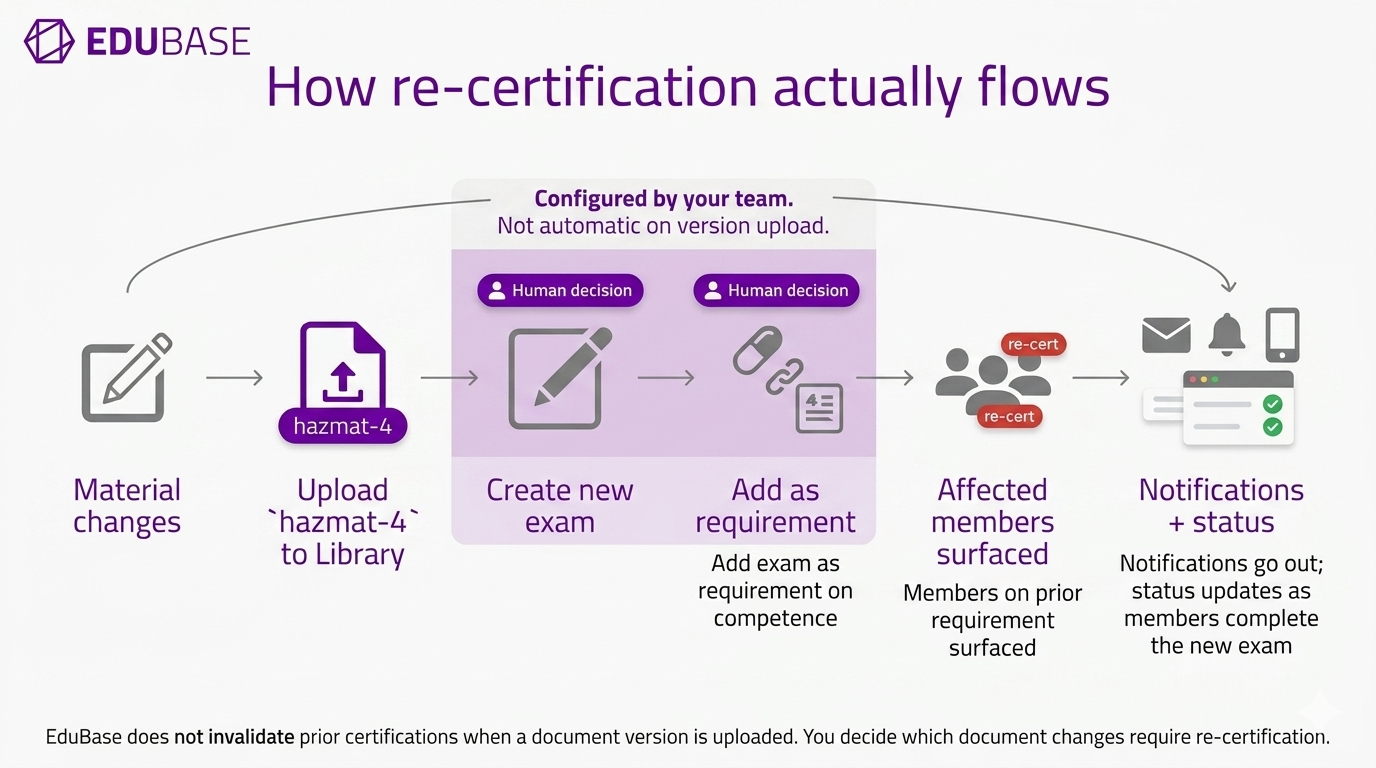
Re-certification is not triggered automatically when you upload a new document version. That is intentional - fixing a simple typo should not trigger re-certification. Your team decides when a change is material enough to require new proof.
The typical flow:
- Upload the revised document to the Library.
- Create a new exam aligned with the updated content (or use an existing exam).
- Add that exam as a requirement on the competence.
- Members who already satisfied the previous exam requirement are surfaced as needing re-certification.
- Notifications go out through the channels configured on your instance (email, SMS, browser, and others, if needed).
- Status updates as members complete the new requirement.
You choose when steps 2 and 3 happen. The system handles the roster and status bookkeeping.
Per-member status and audit exports
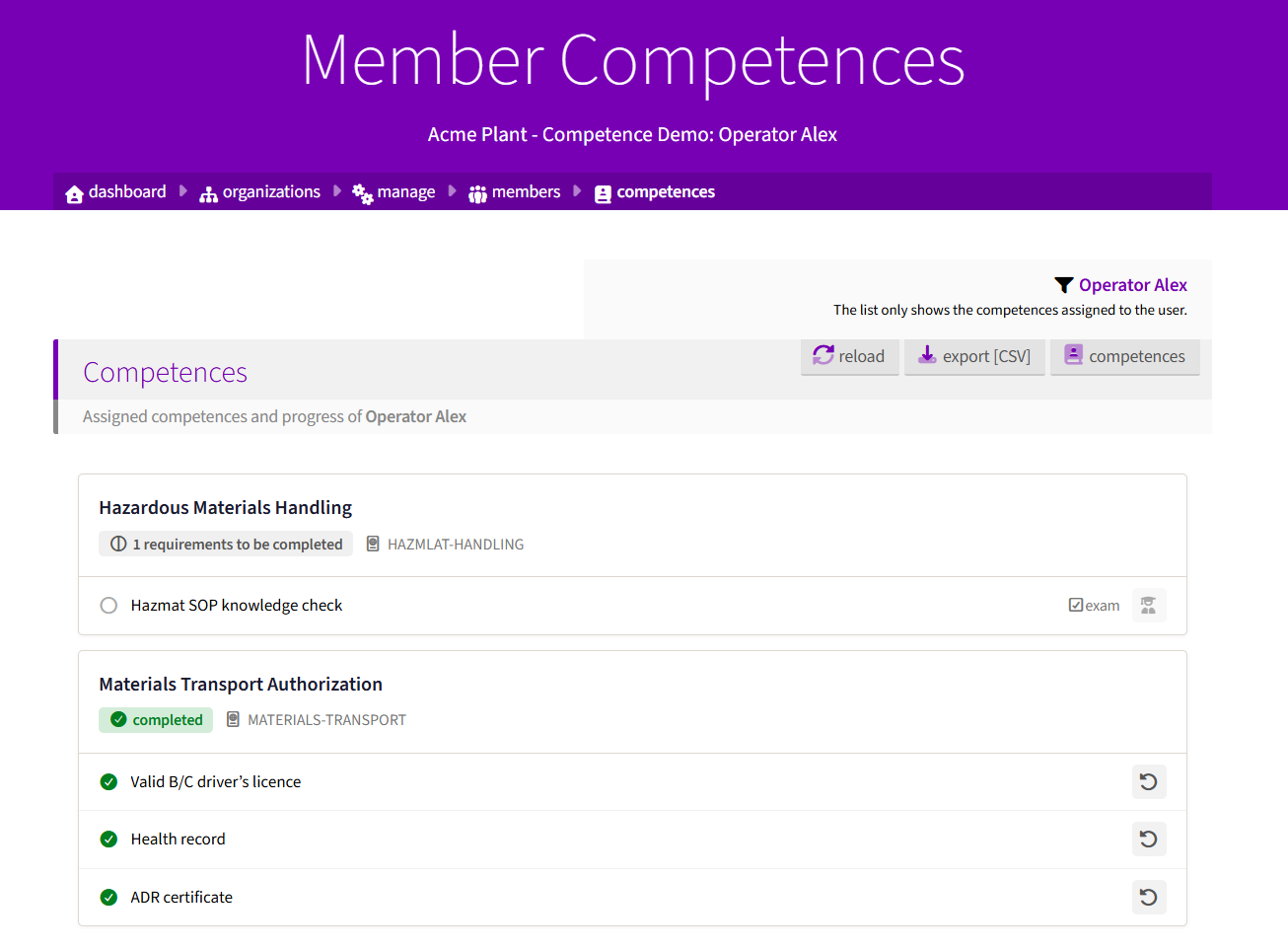
On each member's profile, assigned competences appear with name, description, external identifier where set, current status (for example completed, or N requirements to be completed), and linked documents and requirements.
For audits and compliance officers, the catalog-level CSV export is the standing picture of who holds what, who is overdue, and who still needs re-certification after a material change: organization-wide, in a format that drops into the audit pack or HRIS without rebuilding a skills matrix by hand.
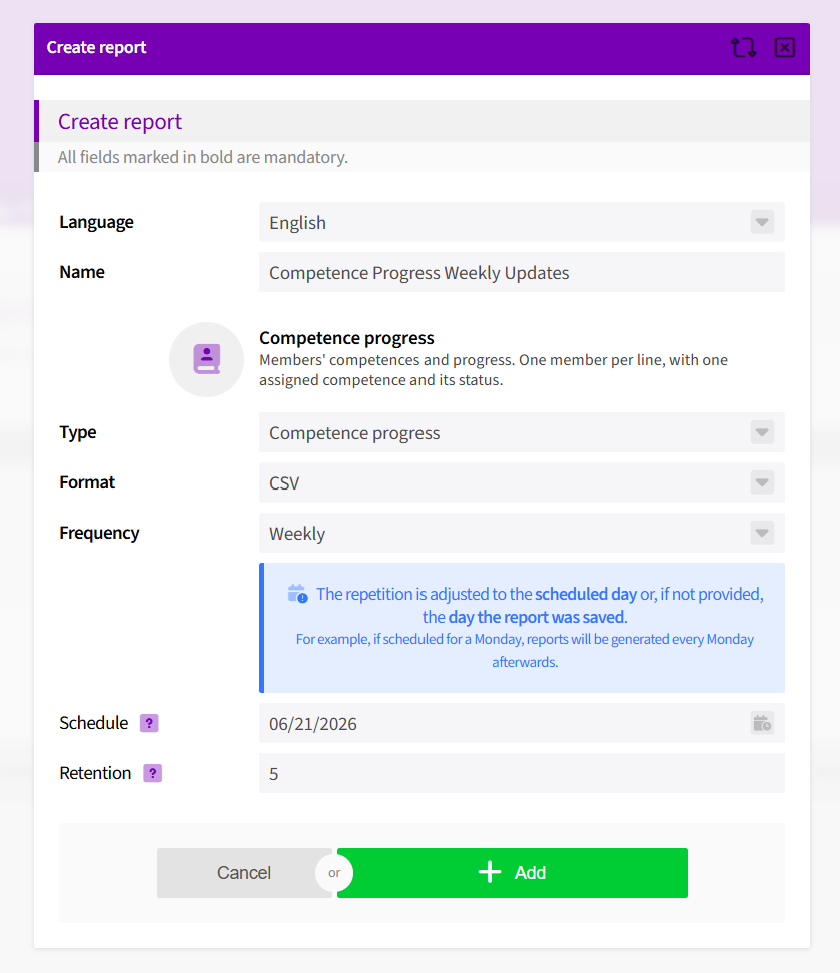
That same picture can run on a schedule, weekly or monthly or on whatever cadence fits your review cycle, so EHS and HRIS workflows draw on current qualification status instead of a matrix someone rebuilds before each audit.
A concrete scenario
A plant revises its hazardous materials handling SOP after a near-miss. The safety lead uploads the new Library version (HAZMAT-4), publishes a new exam, and adds it as a requirement on the Hazardous Materials Handling competence.
Operators who passed the exam tied to HAZMAT-3 show as needing re-certification. Notifications go out. As people pass the new exam, status moves to current. A recurring export keeps the safety team current on who has caught up; when an auditor asks who is qualified on the latest procedure, the answer is already there, not after a week of spreadsheet merges.
Onboarding follows the same model: competences assigned to Line Operations inherit to new hires in that department; digital exams and non-digital milestones (forklift cert, and so on) sit on one competence until the record is complete.
Regulatory context (brief)
If you operate under ISO 45001, ISO 9001 (clause 7.2 competence), or GMP/HACCP-style training, the pattern is the same: evidence that competence matches current controlled material.
Competence Management connects versioned documents, assessments, and per-person status in one place. Optional external identifiers on competences, plus CSV export, help map that picture to HRIS, EHS, or an existing QMS training register where those systems remain the system of record.
See it in your workflow
Competence Management and the Document Library upgrade are on Business today. If you want to map competences to your departments, SOPs, and audit questions, book a demo and we will walk through your case.
Bring a document or a real training requirement and we'll show you the loop end to end.
Or email us at info@edubase.net to discuss and explore your specific needs.