Assessment-as-a-Service: Why AI Agents Need an Assessment Layer
Every AI agent can teach. Almost none of them can verify that you actually learned something. That's the gap we've been building for.

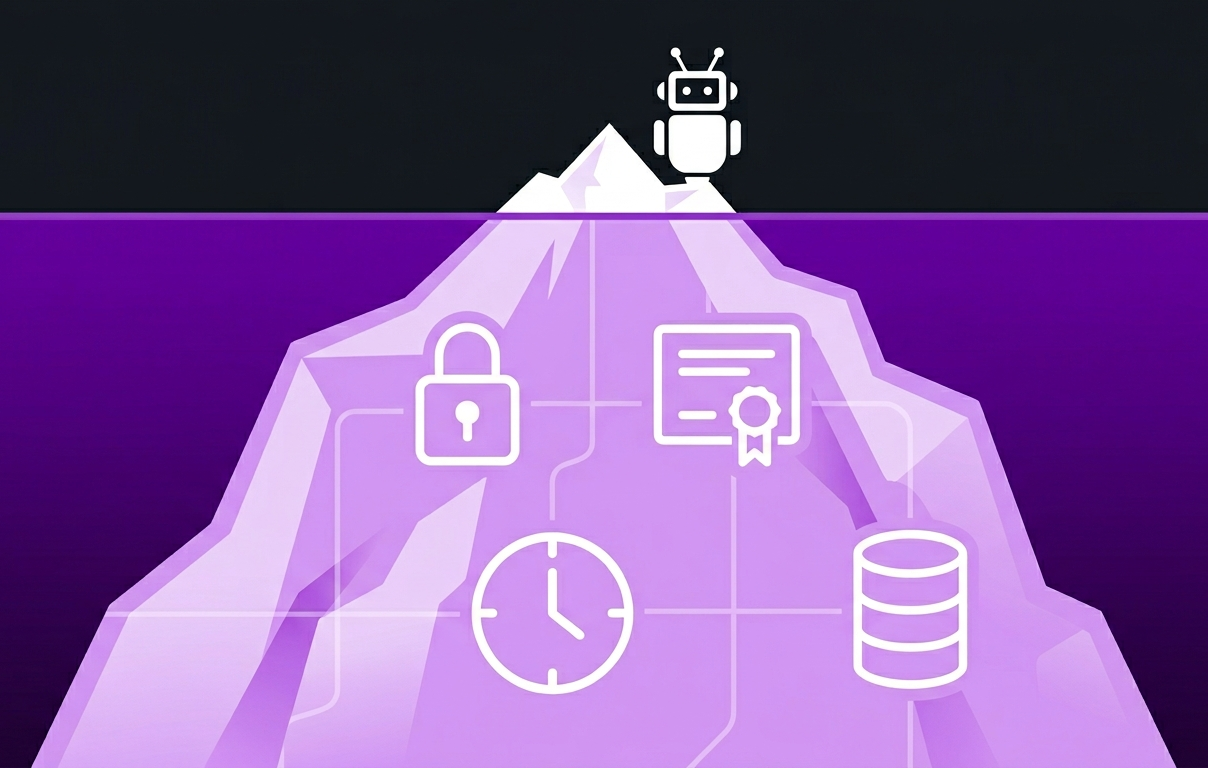
Everyone is building AI agents. Agents that summarize documents, generate flashcards, create study plans, onboard employees, walk you through compliance modules. The tooling is exploding - MCP servers for Slack, Gmail, Google Calendar, Salesforce, GitHub, databases, you name it.
But there's something nobody seems to be building: the assessment step.
AI tutors can explain you concepts all day long. But can it create a verification step (e.g. online exam), administer it under controlled conditions, issue a certificate, and feed the results back into an HR system? As of today, as far as we know, not really. That's an entirely different beast - and it's a key part that will actually matter to institutions, employers, and regulators.
We've spent over a decade building exactly this. And now, with our MCP server, our extensive API, and an llms.txt file that lets any AI system discover our full capabilities automatically - EduBase is aiming to become the assessment primitive that agents call when they need to verify a human's knowledge.
There's a reason assessment is the last step to be automated. Content creation, tutoring, translation, scheduling - AI already commoditised these. Assessment resists that because the gap isn't informational (of knowing what to ask) - rather, it's structural: administering under controlled conditions, scoring with legal defensibility, issuing credentials that institutions and businesses actually trust. You can't close that gap with a better prompt. You need stable infrastructure.
The Missing Verb in Agent Workflows
Think about how agent workflows are composed today. An agent can read (fetch documents, search the web), write (generate content, draft emails), schedule (create calendar events), and notify (send messages). These are verbs backed by MCP servers and APIs.
What's missing? Assess.
"Assess" shouldn't equate to "just generate a quiz." It's a chain of actions that requires deep infrastructure:
- Create dynamic questions (e.g., parametric) making copy-paste cheating structurally impossible
- Support 20+ question types, including mathematical expression evaluation, matrix validation, and hotspot marking
- Administer under exam conditions with time limits, attempt tracking, and proctoring-grade audit trails
- Score automatically - including partial credit, penalty scoring, and hint deductions
- Issue certificates with serial numbers, expiration dates and automated notifications
- Fire webhooks on completion so external systems can react in real-time on certain events
No LLM can do this from scratch. Nor should it. Just like you don't build your own payment processing - you call Stripe - you shouldn't build your own assessment engine. You call one that already exists.
What This Looks Like in Practice
When we launched our MCP server last year, we showed how Claude could create questions and analyze exam results through natural conversation. That was the first chapter: augmenting individual educational builders.
The next chapter is different. It's about agents operating semi-autonomously, with EduBase as one tool in a larger workflow. Here are patterns we're seeing emerge:
The End-to-End Assessment Workflow
An agent reads a PDF (a new regulation, a training manual, a textbook chapter) → generates EduBase questions → assembles them into a Quiz set → creates a time-boxed Exam → assigns a group of users → waits for completion → retrieves results → generates a summary report.
No human in the loop. Fully digital and auditable. The entire pipeline runs on our API, from beginning to end.
Originally, we built this infrastructure for humans. But it turns out that the same atomic, constrained, fully-auditable API that makes EduBase trustworthy for educators also makes it perfect for agents. Every action is small, reversible, and logged. Exactly what you want when an autonomous system is operating on your behalf.
The Reactive Compliance Workflow
Since EduBase supports webhooks that fire on certain events, it means an agent can listen and react to assessment outcomes:
- Employee fails an AML module → agent automatically assigns targeted remedial content and reschedules the certification
- A learner scores below threshold on specific question categories → agent generates follow-up questions focusing on weak areas
- Certification expires → agent creates a refresher exam from updated materials, without anyone filing a ticket
Combined with MCP, this transforms EduBase from a tool you use into infrastructure that participates in automated workflows. The contractor onboarding workflow we wrote about recently? Imagine that entire flow orchestrated by an automation - QR code generation, test assignment, certificate issuance - end to end.
Compliance assessment is where this matters most: because the consequence of a failed verification isn't a bad grade but a regulatory fine; "just ask ChatGPT" isn't an option either. You need audit trails, tamper-proof certficates, scoring, and institutional accountability.
The Multilingual Content Pipeline
We've shown how our MCP integration enables instant translation of assessment content - preserving all important aspects of the material, such as LaTeX, parameters, and pedagogical intent across languages. Now extend that to an agent workflow: source material arrives in English, an agent generates questions, translates them into six languages, creates localized exams for each region, and assigns them to the appropriate organizational units. All through the same API surface.
The Infrastructure Layer, Not the Content Layer
There's a tempting path for any assessment platform right now: use AI to generate massive question banks and compete on content volume. We think that's a race to the bottom. Content generation is commoditizing fast - nowadays, everyone can easily produce multiple-choice questions with an LLM. There's nothing novel in that.
What LLMs can't easily produce is the infrastructure that makes the assessment meaningful:
- Parametric question generation that creates unique variants for every learner
- Smart evaluation that deterministically understand tricky user input (not AI-interpreted)
- Exam administration with attempt limits, time controls, and anti-cheating measures
- Certificate management with serial numbers, expiration tracking, and downloadable PDFs
- Organization and class management with extremely granular permissions
- LTI integration with every major LMS (Moodle, Canvas, D2L, Schoology)
- Conversational Assessments where AI supports learners during the test itself
You bring your materials and have truly unique questions while we provide the engine. And now that engine has an MCP interface, a comprehensive API, webhooks for real-time reactivity, and an llms.txt file for automatic discovery.
And with our recently released EduBase Skills - pre-built agent expertise packages for Claude - the barrier drops further. Skills encode best practices of assessment design knowledge into something an agent can absorb instantly: which question type fits which learning objective, how to parameterise for anti-cheating, how to structure a quiz set versus a timed exam. You don't need to be an assessment expert to build agent workflows that produce expert-level assessments. The Skill handles that.
Where This Leads
There's a counterintuitive dynamic at work. With every new AI model, content gets cheaper to produce - and therefore harder to trust. When anyone can generate materials in seconds, the question is not "can we create learning material?" anymore and starts being "can we prove someone actually learned and understood it?"
We now see that this shift is permanent, and it means the assessment layer becomes more critical with every advance in AI, not less.
We think the next wave of educational technology won't be monolithic platforms doing everything adequately. It will be composed from specialised services - each excellent at its own thing - orchestrated by agents. The agent handles the intelligence: understanding context, making decisions, adapting to learners. EduBase handles the assessment: creating rigorous questions, administering exams, scoring responses, issuing credentials. Each does what it's best at.
This is the same architectural pattern that's winning everywhere in software: specialized, composable services with clean APIs. The difference is that in education, very few platforms were built this way from the start. Our .edu file format, our API, our MCP server, our webhooks - these weren't afterthoughts. They were built because we believed that assessment needs to be programmable, interoperable, and ready for whatever comes next.
What came next turned out to be AI agents.
Try It Yourself
Our MCP server github.com/EduBase/MCP
The pre-built agent skills are at github.com/EduBase/skills
Our full API documentation - including the llms.txt - is at developer.edubase.net
Register for free and use the promo code "MCPEduBaseBlog" at our Integrations page to get API access.
Building an agent that needs assessment? We'd love to hear from you: info@edubase.net